Most small business owners feel lost when it comes to digital marketing. You read blogs, watch videos, listen to the tips of various people – SEO, ads, social media, content, etc – and all this seems significant. The result? You’re unsure where to begin.
The thing is that one does not need to do everything at the very beginning of digital marketing. It involves doing the right things at the right time.
Digital marketing for a small business starts with clear goals, not platforms. Learn how to choose the right channels and grow online step by step.
This is a guide to those businesses seeking clarity rather than confusion.
Start With Your Business Goal, Not Platforms
This is one of the greatest mistakes of small businesses, where one selects platforms without knowing what they want to accomplish. Digital marketing is never to begin with. Should I do Instagram or Google Ads?
It must begin with a simple question:
What result do I actually want?
There are those businesses that desire phone calls. Others desire form enquiries or visits to stores. With such an objective established, all the marketing decisions are made easier. In its absence, marketing activities become haphazardly executed in a way that we have already explained in the context of defining why a large number of small businesses fail to succeed in digital marketing endeavours.
Understand Where Your Customers Are
It is not necessary that every business should be present on every platform. The audience of a local service provider will be very different as compared to the audience of an online brand.
Rather than imitating competition, be realistic. Ask your customers, where do they search and scroll or compare options? Small-business digital marketing is efficient when the effort is concentrated on the areas where attention is already present.
The willingness to select a limited number of platforms and do them well is almost always better than being everywhere and not very consistent.
Create a Website that Helps in your Marketing.
Your site must be prepared before you can run advertisements or do any form of SEO. It is not required to be complicated or costly, but it needs to be understandable.
The right website must respond fast to:
What do you offer?
Who is it for?
So what is the next thing that the visitor should do?
Having visitors come to your site and feel lost will not be remedied by any marketing done. Everything is based on your site.
Choosing Between SEO, Paid Ads, or Social Media
It is where most businesses become stuck. All the channels are valuable, but they are used for different purposes.
SEO assists in creating long-term visibility and trust. Paid ads bring quicker results. Brand presence and engagement are facilitated by social media. It is very important to learn the collaboration between these channels rather than their differences. And in case you have yet to make the first choice on where to invest, our analysis of SEO vs Paid Ads can give you this perspective.
It does not have to do with picking everything. It is making a decision based on today’s sense.
Start small and be Consistent.
Digital marketing is not a one-time activity. Results come from consistency, not intensity
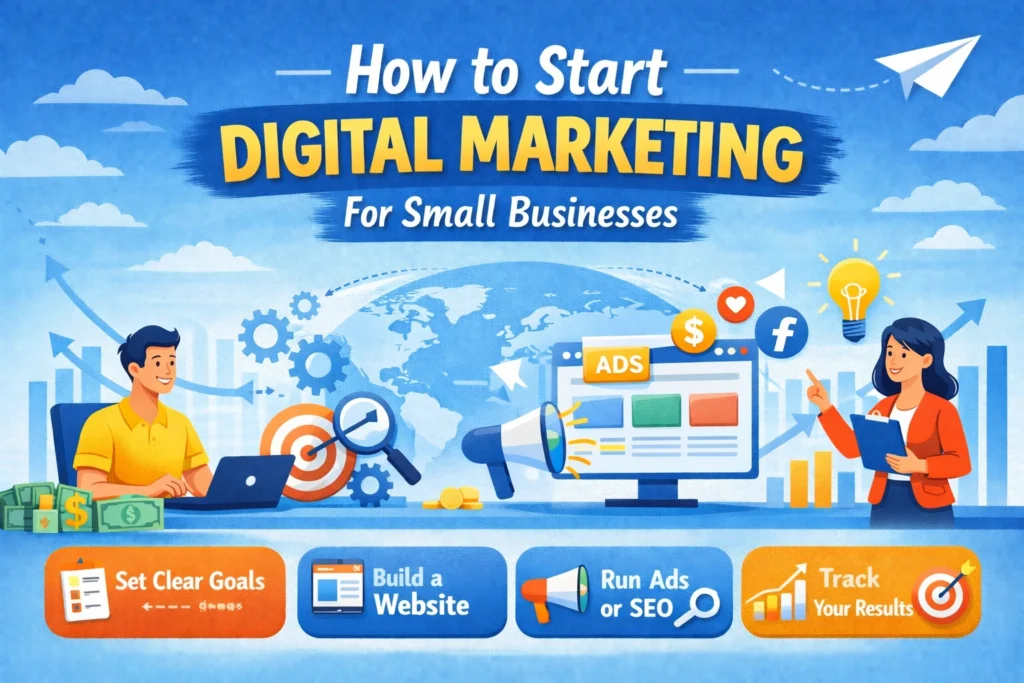
You do not have to launch five campaigns simultaneously; rather, begin with a basic plan during the first month:
Fix basic website issues
Select a major promotional medium.
Set one measurable goal
Track what’s working
The given strategy assists in reducing the overload of the content and streamlining the progress process.
These Are the Most Common Beginner Mistakes to Avoid.
The majority of small businesses fail at digital marketing not due to their lack of attempts, but due to the haste or their desire to see immediate outcomes. Attempting to scale without testing, being careless with clarity in the website or quitting prematurely are all pitfalls. Online marketing favours patience and learning. Each little successive step adds to the momentum.
Final Thoughts
Digital marketing may not seem as complex as it can seem to initiate as a small business. With defined objectives, platforms are never selected without wisdom and effort; digital marketing becomes much easier to manage.
You do not have to do everything. You just need to start smart.
Frequently Asked Questions
Q1: What is the way to start digital marketing as a small business?
A small business must begin with having a single objective, like receiving calls or enquiries. Rather than experimenting on all platforms, it is more important to stick to a single channel and develop a presence first before diversifying.
Q2: What is the initial step of digital marketing for a beginner?
The initial one is to know your customers and to make your site ready. Do not invest in advertisements or SEO before you make sure that visitors are fully aware of what your service is and how to get in touch with you.
Q3: Do small businesses need a website before starting digital marketing?
Yes. The internet marketing base is a site. Even simple campaigns will be better in case of a decent, trustworthy webpage behind them.
Q4: Which is better to begin with: SEO or paid advertisements as a small business?
Paid advertisements are good in providing immediate visibility, whereas SEO provides long-term traffic and credibility. A lot of small businesses are able to make their initial investment in advertising and invest in SEO as they grow to sustain themselves.
Q5: What is the amount of funds required to commence in digital marketing?
There is no fixed budget. Digital marketing can even begin with a limited budget if it is focused properly. Having clear targeting and consistency is more important than the size of the budget.
Q6: How long does it take to see results from digital marketing?
Some of the strategies, like paid advertising, may achieve results in a relatively short time, but SEO can only be achieved after many months. A combination of the short and long-term strategies leads to better performance by most businesses.
Q7: Can small businesses do digital marketing on their own?
Yes, though there are lots of problems that occur without instructions. A plan or professional guidance will help to save time, money, and unjustified frustration.