
Digital marketing is often presented as something simple. Build a website, post regularly on social media, maybe run a few ads — and customers will start showing up. For many small businesses, this sounds promising at first. But after a few months, reality feels very different.
Money is used, time is spent, but the outcomes seem to be uneven or vague. Gradually, the owners of the business start to think that digital marketing simply does not work for them. That is not the case in most instances.
Small business digital marketing usually fails not because of a lack of effort, but because the approach itself is flawed.
Starting Without a Clear Direction
Most small businesses enter the digital marketing field due to the pressure to be online or when their rivals are already online. It is a reactive decision that is not a strategic one.
It seems that without a clear goal, everything will be disconnected. An advertisement is not supported by social media posts. Ads don’t match the website messaging. The website doesn’t guide visitors toward any specific action. Marketing exists, but it doesn’t move the business forward.
The fix starts with clarity. A business must choose what it really desires: more phone calls, more enquiries, more bookings or local presence. Digital marketing is simpler to plan and evaluate once a distinct goal has been established.
Trying to Do Everything at Once
Another major reason small businesses struggle is the urge to be everywhere. SEO, Instagram, Facebook ads, Google ads, blogs, reels — all started together.
This usually leads to:
- Inconsistent posting and campaigns
- Limited budget spread too thin
- Burnout without clear results
Small business digital marketing works better with focus. One or two well-chosen channels, handled consistently, almost always outperform multiple half-managed platforms.
Growth doesn’t come from doing more. It comes from doing the right things well.
Expecting SEO to Deliver Instant Results
One of the most misconceived aspects of online marketing is SEO. Most of the businesses anticipate fast ranking and instant traffic, particularly when promises are made that it is too good to be true.
The reality is simple. SEO takes time. It builds authority gradually and delivers results that compound over months, not days. When SEO is treated as a quick fix, disappointment is almost guaranteed.
A smarter approach is balance. As much as paid advertisements can be used to generate quick exposure, SEO provides a solid base for future growth. The combination of the two makes the outcomes more predictable and stable.
Bringing Traffic into a Site that Does not Convert.
Even when marketing starts bringing visitors, results can still fall flat. This often happens because the website isn’t doing its job.
Many small business websites look decent but lack clarity. Visitors struggle to understand what the business offers, who it’s for, or what to do next. When that confusion exists, people leave — no matter how they arrived.
A good website should quickly answer three questions:
- What service or product is offered?
- Why should someone choose this business?
- What action should the visitor take next?
When these answers are clear, marketing efforts become far more effective.
A Situation Many Small Businesses Face
Imagine a local clinic trying to attract new patients. They run ads and see website traffic increase, but enquiries remain low. The phone number is hard to find, booking an appointment isn’t obvious, and there’s little local trust shown.
Eventually, the clinic stops advertising, assuming it didn’t work.
In reality, the traffic was real. The problem was the experience after the click. With clearer messaging and a better call to action, those visitors could have turned into real patients.
Ignoring What the Data Is Saying
Many small businesses continue digital marketing without tracking results properly. They don’t know which channel brings leads or which content performs best. Decisions are made based on assumptions rather than insights.
Even basic tracking can reveal what’s working and what isn’t. When businesses understand their data, they stop restarting marketing efforts and start improving them.
Copying Big Brands Instead of Being Relevant
Big brands have large budgets, strong recognition, and dedicated teams. When small businesses try to copy their strategies without adapting them, results usually disappoint.
Small business digital marketing should focus on relevance, intent, and trust — especially at a local level. Customers aren’t looking for flashy campaigns. They’re looking for solutions that feel reliable and clear.
What Actually Works for Small Businesses
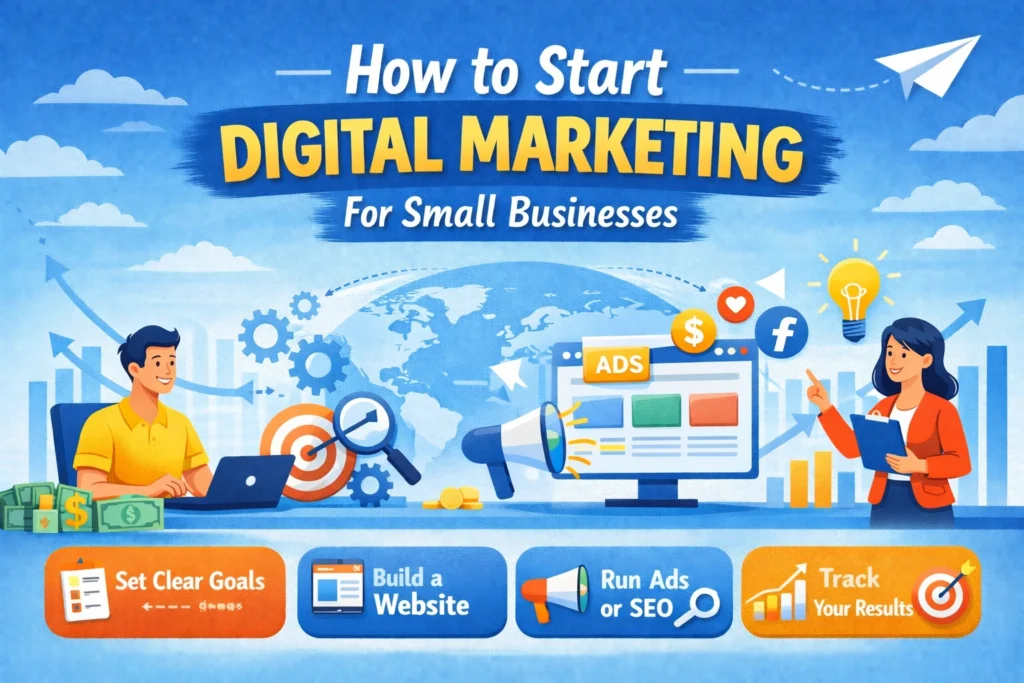
Digital marketing starts working when businesses focus on the fundamentals:
- A clear goal
- The right channels
- Consistent execution
- A website built to convert
Once they collaborate and do not pit each other with the assistance of SEO, content, and paid work, the growth will be more manageable and sustainable. Comparisons between long-term and short-term strategies, such as our SEO vs Paid Ads argument, can assist businesses in making better decisions.
Final Thoughts
The reason why most small businesses fail in digital marketing is that they do not work hard. They are ineffective in the sense that they were not well structured, there was no clarity and realistic expectations.
With the right approach to it, digital marketing will cease being perceived as an intimidating concept but as a valid instrument of growth. There is no such thing as an overnight affair; it is a gradual process, and that is what real success is.
Frequently Asked Questions
Q1: Why does digital marketing not work with most small businesses?
Online marketing tends to fail since it is initiated without a definite strategy. Most of the small businesses will experiment with numerous platforms simultaneously, demand immediate outcomes, or invest without knowing their audience. Disagreements in goals, timeframes, and plans make outcomes disillusioning.
Q2: Is digital marketing worth it to small businesses?
Digital marketing is worth it, yes, when it is done right. Small business online marketing is most effective when it is not a hasty experiment and is systematic and purposeful as a long-term process of growth.
Q3: What is the duration of the digital marketing to demonstrate the results?
Advertisements can make a swift appearance; in some cases, the results are experienced in days or weeks. The process of SEO typically takes a couple of months to gain momentum. Combined short-term and long-term strategies are more effective in most small businesses.
Q4: What is the largest error occurring in digital marketing by small businesses?
Among the largest errors is that one attempts to do much without focusing on a single task. Mimicking other companies, neglecting the visibility of sites, and failing to measure the performance would tend to yield bad results.
Q5: What should small businesses begin with: SEO or paid ads?
No one-fit solution exists. Paid advertising is used to achieve a short-term presence, whereas SEO is used to earn potential long-term confidence and traffic. The balanced approach is the most effective in the majority of small businesses.
Q6: Does digital marketing have a small budget?
Yes. Even a small budget can work when targeted at the appropriate channel. It is the smart targeting, clear message and consistency that tend to be more important than the amount of money being used.
Q7: Does a digital marketing agency need to be used by a small business?
Not always, but help in the form of guidance. A great deal of failures occur because of the lack of experience or an ambiguous strategy. Provided with the right support, one will be able to prevent a number of mistakes and establish a better digital marketing base.